Loading Experience
Best viewed in Chrome or Firefox · Safari screens the short version
The first actors were priests standing over graves — letting the dead speak through them.
A woman joins her fiancé in a theater residency and gets cast.
Literally.
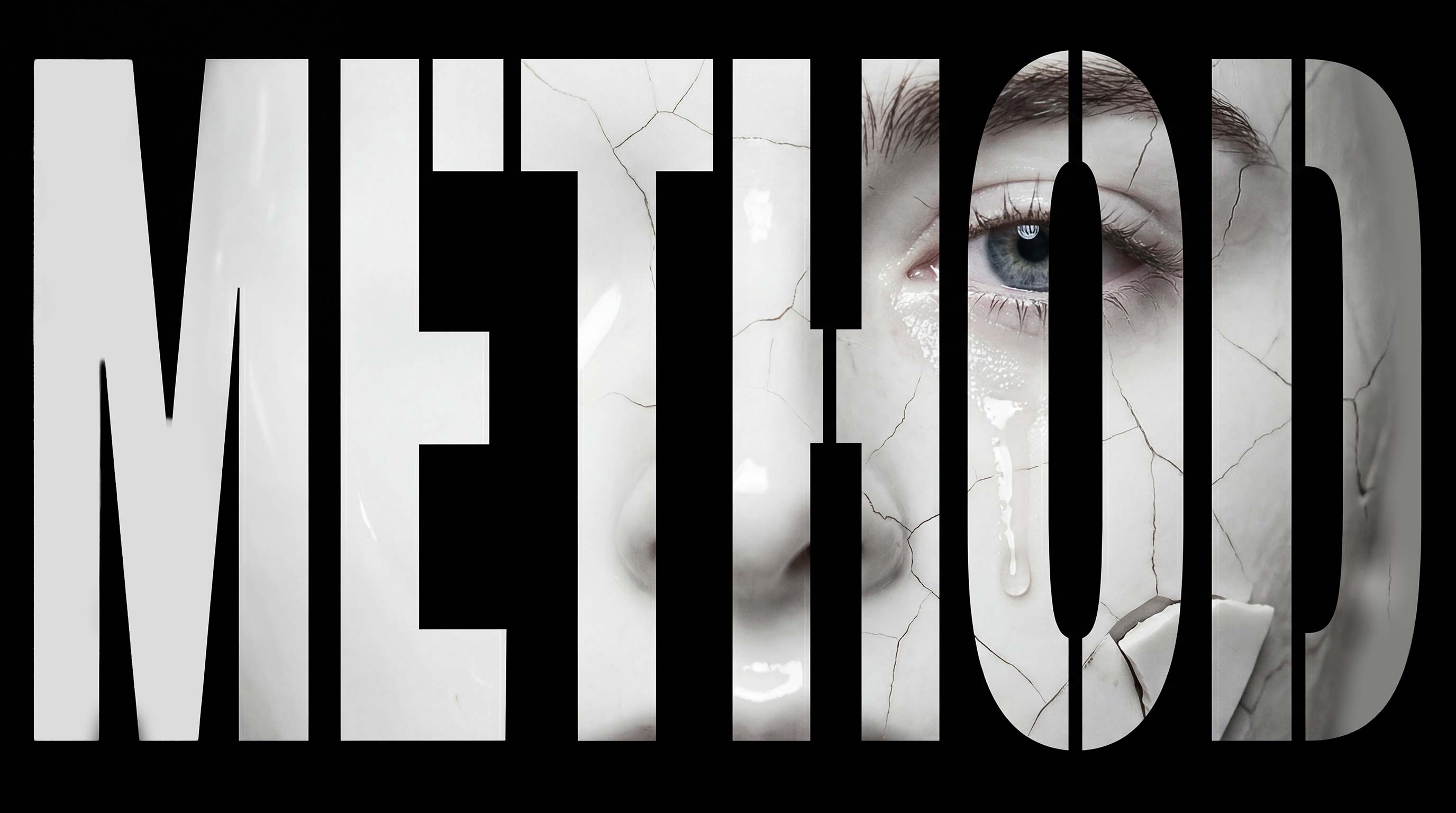
Stay Broken.
Most horror films are about something trying to kill you.
METHOD is about something trying to cast you.
Not a haunting. Not a possession. A replacement.
Five years after her sister died, Jen arrives at an isolated theater for an eight-week production under a director no one has seen in 25 years.
Adam thinks the director is going to make him a star.
The director has never been interested in Adam.
The director is dying.
Two years ago, Adam wrote him a letter and gave him everything — Jen’s therapy transcripts, her family history, the truth about her sister’s death.
The director rewrites the play around her. Lines from her therapist’s office show up in the script.
By the time Jen realizes what’s happening, her understudy has been rehearsing her — gesture for gesture, breath for breath.
Jen finds Adam buried behind a restaurant — in pieces, clean as carving. The man who comes home that night looks like him, sounds like him, and reaches across the room with an arm too long.
The town fills with copies. Hollow shapes hitting their marks right on cue.
In the wings, a clay Jen is being fitted to take her place.
Opening night. The seats are full.
Jen takes the stage and goes off-script.
The molds fracture. The copies dissolve.
Jen walks out the front door and doesn’t look back.
Everyone looks right. Almost.
METHOD plays as a chamber drama for most of its runtime.
Two people in a room. A rehearsal. A diner conversation.
A phone call to a mother who won’t answer.
The horror lives in the tells.
By the time the rules break at page 60, the audience has been watching them get built for an hour.
YOUR HOUSE IS YOUR THEATER.
YOU PERFORM YOUR LIFE.
Something has been watching it.
Studying it.
Rehearsing it.
Your understudy is watching.
To take your place.
METHOD hits three groups of people— and all of them will talk about this movie.
Late 20s – 40s
They did the therapy. They said the words. They posted the update. They’ve started to wonder if they healed or just got better at the performance.
They’ve been someone else’s architecture.
Asked to hold the weight of another person’s damage without ever being allowed to set it down.
18 – 25
They’ve been watched since before they had a choice. Every version of themselves documented, studied, scraped.
They’re not afraid of being seen. They’re afraid of being learned.
91% of them watch horror — the highest share of any generation.
Her sister Amy died waiting for Jen to pick her up.
Jen was late.
She has never said why.
Since then, Jen has been performing “fine.”
The director has been studying her performance.
He wants to cast it.
This role doesn’t make her.
It reveals what’s underneath.
METHOD doesn’t ask you to be afraid of the dark.
It asks you to be afraid of the person holding you while the lights are on.
Two years ago, Adam wrote the director a letter.
Jen’s fiancé loved her and sold her anyway.
The Villain · The Castor
He doesn’t direct. He feeds.
What keeps Marcus alive is authenticity. Not pain. Not grief. Genuine human feeling — the kind that passes through an audience when two hundred strangers feel the same thing at the same time.
Marcus is dying.
It’s not Jen’s pain he wants. It’s what her pain makes an audience feel — what passes through two hundred strangers when they cry for the same woman at the same time.
He doesn’t make plays. He builds meals.
For decades, every leading lady has been a course.
Victoria Sterling was his last.
Jen is his next.
His system has one flaw:
he can only feed on performance.
The night Jen stops performing,
he starves.
The Replacement
When it’s ready, it takes your place.
It lives your life. It plays your role.
No one knows the difference.
You don’t disappear.
You get performed.
Humans heal. Clay doesn’t.
A real wound can only be performed so many times before it closes. The replica keeps it open.
Same break. Eight shows a week. Forever.
Jen goes to the police.
The officer nods. He says “we’ll look into it.”
He writes nothing down.
The detective’s mouth moves. No sound comes out.
The janitor wrings a bone-dry mop into an empty bucket.
They are Background.
So is the waitress. So is the local man at the diner. So is the couple who held the door.
They performed caring. They performed kindness. They performed connection.
Help was never coming. Help was the production.
Everyone you thought was real—
Was cast.
Marcus builds everything around grief.
Because it’s easy to copy.
Tangible. Repeatable. Profitable.
But Jen feels two things at once.
Grief—and something else.
That’s the fracture.
A mold can only hold one shape.
The Understudy captured Jen’s guilt —
the grief. The wound.
But Jen isn’t holding guilt. She’s holding nostalgia.
A mold can’t hold what it didn’t receive.
That’s how she breaks it.
A generation that’s always performing is dying to watch someone stop.
Your kid can’t fail in public without it living online forever. Your niece won’t cry at a funeral because someone might post it. Your intern has a therapy vocabulary and no idea if she’s actually okay or just knows the words.
Everyone is performing — their grief, their healing, their breakdowns. Most of them don’t know they’re doing it.
Authenticity is the scarcest thing in the culture. That’s why when someone actually delivers it, the whole room feels it.
Jen does the one thing nobody is allowed to do anymore. She stops.
The first generation to grow up inside it has no horror movie for it yet.
METHOD is the first.
Braddock is a place that was poured out.
The industry took what it needed.
Everything else was left behind.
The town kept its shape — around something that’s gone.
The office buildings. The mall. The corner store.
Still here.
But hollow.
That’s the Method.
Every decade has its horror.
The fear of the 2020s is Replacement.
You weren’t killed. You weren’t possessed.
You were recast.
METHOD is the first horror film about that.
Marcus built his theater on one transaction:
People pay to watch someone else’s pain.
On opening night, Jen breaks the script.
They came to consume her pain.
They don’t survive what she gives them instead.
The Drama Is the Trap
This is a relationship drama. Jen and Adam. Jen and Amy. Jen and Marcus. If the actors play horror, it breaks. I direct the drama. The horror comes from the audience realizing what’s really happening.
The Form Is Surveillance
The apartment is a set. Walls come off. The camera goes where it shouldn’t—behind drywall, through a peephole, into private space. We’re not just watching Jen. We paid Marcus to watch her.
Observational Horror
No tricks. No winks. Everything is played real. The world creates the fear. Not the camera telling you how to feel.
The Vibe
REPULSION — isolation.PERSONA — identity collapse.ROSEMARY’S BABY — the conspiracy of intimacy.
METHOD is a horror film about performing your own life.
This weekend, two original horror films from first-time directors topped the box office.
Backrooms opened to $81 million — the biggest horror debut of the year. Obsession crossed $100 million in three weeks.
Both atmospheric. Both dread-based. Neither has a single jump scare.
Smart, original horror isn’t a niche anymore. It’s the #1 movie in America.
Horror is now 17% of every ticket sold in North America — quadruple what it was a decade ago.
METHOD is built for that audience. Same lane. Same dread. Different scare.
$750K → $150M · and climbing
$10M → $118M · opening weekend
$4.5M → $92M
$10M → $127M
Jen is the role that makes someone a star — ninety minutes of restraint, then a ten-minute monologue that tears the whole movie apart.
Every horror breakout of the last decade was built on a female lead doing something she’d never been allowed to do on screen. This is that role.
For years, Jen has been fixing Amy’s broken ceramic ballerina.
Every crack filled. Every seam made beautiful.
She told herself it was healing.
It was gilding.
At the end, the ballerina is broken again.
This time, Jen doesn’t fix it.
She leaves it in pieces—and walks away.
Jen stops trying to make it look okay.
Stay Broken.
The break is the only proof you were real.
Thank You
Stay Broken.
SHE BIT DOWN. THE MOLD BROKE.
Stay Broken.